Paula's

Mito Mission

Based in Wincham, Cheshire

Hi, I’m Paula. I live in Northwich, Cheshire and I was diagnosed with mitochondrial disease in 2021 in my early 40s after experiencing vision loss....

Read

Read arrow

Paula's

Story.

June 2026

Paula at Manchester 10k

I have always been a fiercely independent person. From the age of 16, I worked hard and took pride in building my own path in life. Despite suffering from severe migraines from childhood, I was determined not to let anything hold me back. That determination stayed with me when I was diagnosed with dyslexia and dyspraxia at university- something that came as a shock, as it hadn’t been recognised when I was younger. Still, I pushed forward and achieved a first-class degree in Sport Science.

I went on to build a career, progressing into management roles and continuing to strive for more. I had a strong sense of purpose, independence, and direction.

Then, during the pandemic,

everything changed.

I noticed I was struggling to drive at night. When opticians reopened, I made an appointment, expecting a minor issue. Instead, I was told I had lost all central vision in my left eye. I was referred to specialists and, during appointments I had to attend alone due to COVID restrictions, I was told I had a rare, progressive condition that would lead to vision loss in both eyes. There was no treatment. I would no longer be able to drive.

Paula long blob

In my early 40s, I was suddenly facing the loss of my independence.

Eighteen months later, after further investigations, I was diagnosed with mitochondrial disease (MIDD). I was told I would need genetic counselling and specialist care far from home in Newcastle. I was still trying to come to terms with losing my sight, and now I had to process a complex, life-limiting condition that affects multiple systems in the body.

For me, it brings overwhelming fatigue, muscle weakness, low energy, hearing loss, vision loss, and heart complications. It affects every aspect of daily life.

Mitochondrial disease is often called an “invisible illness,”

but its impact is profound.

Paula on holiday

I always hide my eyes now as much as I can with my sunglasses. To protect them and as I feel very self-conscious and have very low self-esteem. They feel like protective armour now to me.

What made it even harder was the isolation. There were no local support networks or specialist services available to me in the North West. I felt completely alone, searching for someone who understood. Eventually, I found support through online communities and charities, people who truly understood what living with this condition means. That connection made a world of difference.

However, the challenges didn’t stop there.

I lost my job when my employer was not prepared to make reasonable adjustments for my condition. I faced a tribunal process alone, with no prior knowledge or support. Although I won, the emotional and physical toll was immense, and due to legal loopholes, I never received the compensation awarded to me.

Paula next to Manchester City sign
Paula and Angela doing 10k run

Around the same time, my personal life also changed dramatically. My partner of ten years left, and I lost my home. It felt like everything I had built had been taken away in a very short space of time.

 But even in those darkest moments, I knew I could not give up.

In 2026, I decided to take on the huge challenge of running in the Great Manchester 10k, to raise funds and awareness for My Mito Mission. I ran with my cousin Angela as my sighted guide, who is an incredible person who has always dedicated her time to helping others. Despite her own commitments, she committed to helping me train and complete this challenge. She is my safe place. She is so patient with me, and she sees me before my disability.

Even getting to the start line was a challenge, and it was impossible to know how my health would be on the day. But I made it through and raised over £650 for this fantastic charity.

For many, a 10k is just a run. For me, it was proof that mitochondrial disease does not define me, and a chance to make a difference for others living with this condition.

I want people to understand that living with mitochondrial disease is not just about managing symptoms; it is about navigating a world that often doesn’t see or understand what you are going through. It is about fighting to be heard, to be supported, and to maintain dignity and independence.

That is why charities like My Mito Mission are so important. They provide not only information and advocacy, but also a sense of community- something that can be life-changing for people who feel alone.

Paula with little boy

My hope is that,

by sharing my story,

 I can help raise awareness of mitochondrial disease and the realities of living with it. I want to help create better support systems, especially in areas like the North West where access to specialist care and community support is limited. 

I want every person affected, adults and children alike,

 to feel seen, heard, and supported.

If sharing my journey can help even one person feel less alone, or encourage greater understanding and support, then it will all be worth it.

Any support for my

mission will be appreciated.

Paula with dog

Get involved and

support Paula's cause.

Paula's logo no strap

Any funds raised by Paula’s mission goes to My Mito Mission’s
central funds to be granted towards research and support projects
to benefit everyone affected by mito.

Spreading the word, following, sharing, as well as donating and raising funds are all really helpful and valued. From running a race to holding a bake sale, hosting a collecting can to giving out Paula’s Mito Mission leaflets – there are so many ways in which you can get involved.

If you’d simply like to donate to Paula’s mission, choose a way that suits you below.

Be a Part of Project 1000 Strong

Regular donations are the most powerful way to support our vital work, allowing us as a small, high-energy charity to plan and build from a strong foundation.

Strengthening the future of mito awareness, support and research.

We need a 1000 strong team of amazing people to donate any amount from just £2 a month. 1000 is a lot, but – one by one – we know that we can reach it.  Find out more here.

Support Paula by Joining Project 1000 Strong!

For any other amount or frequency (eg weekly, quarterly, annual), simply contact us

Fundraise for Paula’s Mito Mission

We’d love your support with our fundraising… and we can provide supporting materials. Just ask!

JustGiving Logo

Set up a fundraising page (Use the orange ‘Fundraise For Us’ button)

Facebook Fundraiser

Set up a Facebook fundraiser by clicking above and searching for 'My Mito Mission'
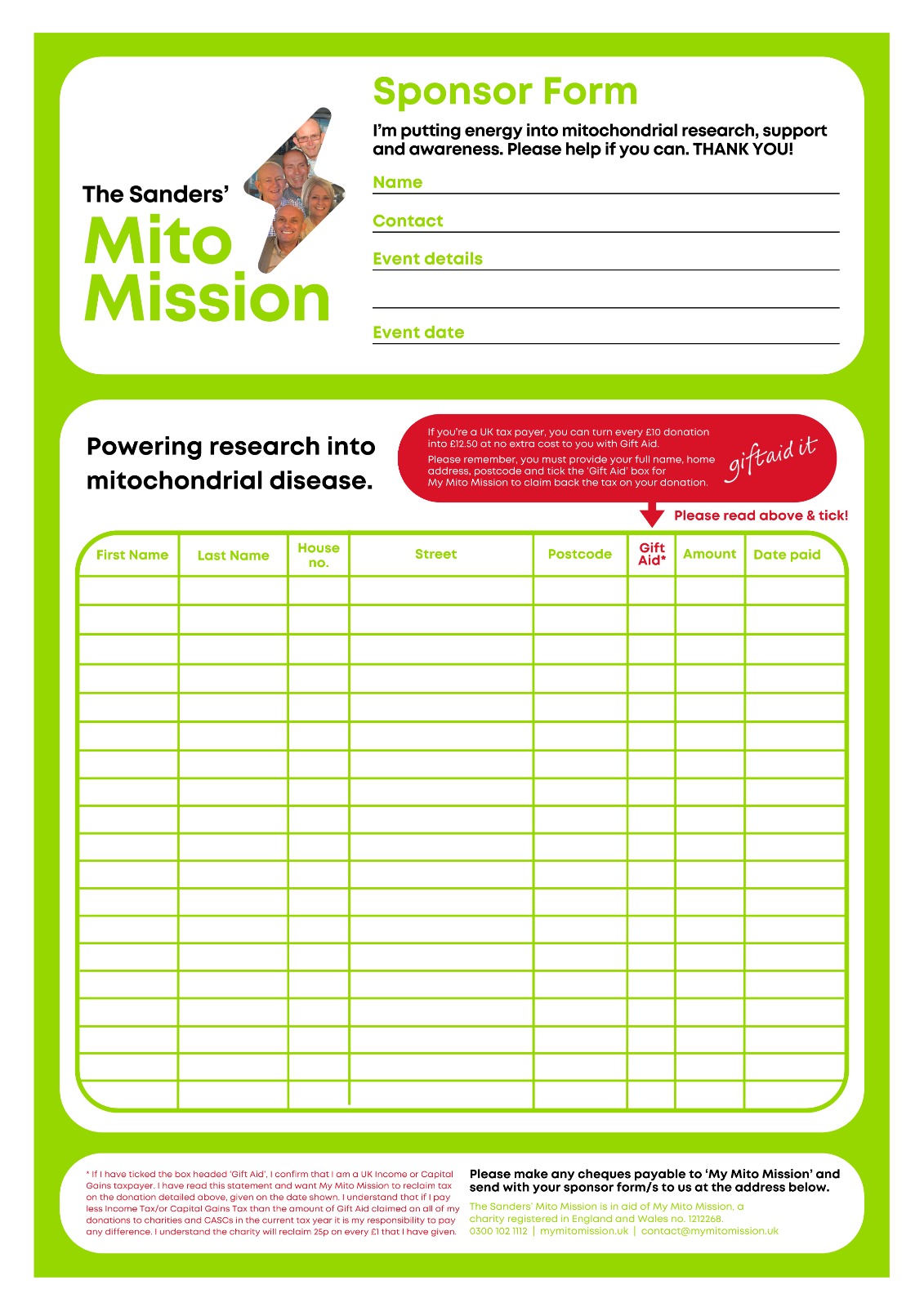
Sponsor Form

Download a sponsor form to print off by clicking the image above

Collecting Can

Support materials such as buckets, cans, leaflets and more

Change Box

Ask anyone you know to have a Change Box, Small change - Big difference!

Fundraise and shop!

ebay Logo

Find our ebay shop easily by clicking 'Save seller'

Vinted logo

Visit our second hand clothing shop and follow our account

Amazon wishlist logo

Support us by purchasing something from our Amazon Wishlist

Give as you live

Support us for free at 100s of stores - click the ‘Find your charity’ button

Paypal Giving logo

Click the heart under our charity number to set us as your favourite charity

Other ways you can support us

Nominate

Nominate Paula's mission for support at your work or club

Collect

Collect saleable, used items that we can sell in our ebay shop

Merch

Check out the merch in our shop to raise awareness and funds

Talk to club or organisation

Let us talk to your organisation about our cause

Events

Come to our events and help us raise vital mito awareness and funds

Visit our Support Us page for more inspiration!
Check out My Mito Mission’s Facebook Page, Twitter & Instagram too!
Every like, comment and share counts.
Paula's logo no strap