Postdoctoral Researcher Funding – Interview with Elena Britti

My Mito Mission is supporting an exciting research project at UCL that aims to deepen our understanding of mitochondrial disease and explore new possibilities for treatment.

We believe that looking beyond mitochondrial disease itself, and exploring connections with other conditions, could help accelerate discoveries and bring us closer to effective treatments for people affected by mitochondrial disease.

Here, post-doctorate researcher Elena Britti explains how the project is exploring these connections and what she hopes it will achieve.

What attracted you particularly to this opportunity?
From my undergraduate studies onward, my research career has been driven by a deep enthusiasm for mitochondrial research. In fact, I consider myself a ‘Mitochondriac’. Recently, I spent some time working outside mitochondrial research, and that experience made me realise how much I missed it. This opportunity allowed me to return to the research area I am most passionate about, while contributing to a project with potential to improve patients’ lives.

What do you look forward to most about working with Antonella, and the project in general?
Working with Antonella Spinazzola means working alongside someone who is incredibly hardworking, creative, and genuinely passionate about mitochondrial research. I’m excited to learn from her and to make discoveries together. What particularly excites me about this project is that we are looking at links between conditions that are usually studied separately, such as rare mitochondrial diseases and Parkinson’s disease.

Can you explain this research project in simple terms, for somebody who might not know much about science?
Some individuals with rare mitochondrial diseases can develop symptoms that resemble Parkinson’s disease, a neurodegenerative disorder that typically occurs later in life. We want to understand what connects these two conditions. By taking skin cells donated by patients with these rare diseases and reprogramming them into the type of brain cells affected in Parkinson’s disease, we can investigate what is happening inside those cells. We will then compare them with brain cells made from people with Parkinson’s disease. By looking for common changes between the two, we hope to uncover what links these conditions and identify new ways of treating them in the future.

Why would you say this research is important right now?
We have known for some time that there is a connection between mitochondrial function and Parkinson’s disease, but there is still a lot we don’t know about that connection. Rare diseases can inform common forms of neurodegeneration, so we have an opportunity to make discoveries that could benefit both groups of patients. My Mito Mission recognises that mitochondria play a role in many different diseases and provides the support needed for pilot studies like this one.

How do you measure progress in a project where results may take a long time?
For me, progress isn’t measured only by the final result. Every experiment, every new piece of data, and every question we answer brings us one step closer to understanding the mechanisms of diseases. Research takes time, but consistent effort towards a final goal, collaborations with other scientists, and learning from others are what lead to meaningful discoveries. As an infinite puzzle to solve, you enjoy the process. You may never see the infinite puzzle completed; however, it’s incredibly rewarding to know you’ve helped reveal a much bigger picture.

How does your work fit into the bigger picture of research happening globally?
Mitochondria are involved in far more diseases than people often realise. My work aims to connect the dots between genetic forms of mitochondrial diseases and Parkinson’s disease. By connecting diseases that are usually studied separately, we have the opportunity to make discoveries that could have a much broader impact. This knowledge could eventually allow us to repurpose treatments developed for rare mitochondrial diseases to benefit Parkinson’s patients and vice versa, as well as discover new therapeutic targets for both groups of patients along the way.

Postdoctoral Researcher Funding - Interview with Elena Britti

Elena Biritti My Mito Mission is supporting an exciting research project at UCL that aims to deepen our understanding of mitochondrial disease and explore new possibilities for treatment. We believe that looking beyond mitochondrial disease itself, and exploring connections with other conditions, could help accelerate discoveries and bring us closer to effective treatments for people affected by mitochondrial disease. Here, post-doctorate researcher Elena Britti explains how the project is exploring these connections and what she hopes it will achieve.

What attracted you particularly to this opportunity?
From my undergraduate studies onward, my research career has been driven by a deep enthusiasm for mitochondrial research. In fact, I consider myself a ‘Mitochondriac’. Recently, I spent some time working outside mitochondrial research, and that experience made me realise how much I missed it. This opportunity allowed me to return to the research area I am most passionate about, while contributing to a project with potential to improve patients’ lives.

What do you look forward to most about working with Antonella, and the project in general?
Working with Antonella Spinazzola means working alongside someone who is incredibly hardworking, creative, and genuinely passionate about mitochondrial research. I’m excited to learn from her and to make discoveries together. What particularly excites me about this project is that we are looking at links between conditions that are usually studied separately, such as rare mitochondrial diseases and Parkinson’s disease.

Can you explain this research project in simple terms, for somebody who might not know much about science?
Some individuals with rare mitochondrial diseases can develop symptoms that resemble Parkinson’s disease, a neurodegenerative disorder that typically occurs later in life. We want to understand what connects these two conditions. By taking skin cells donated by patients with these rare diseases and reprogramming them into the type of brain cells affected in Parkinson’s disease, we can investigate what is happening inside those cells. We will then compare them with brain cells made from people with Parkinson’s disease. By looking for common changes between the two, we hope to uncover what links these conditions and identify new ways of treating them in the future.

Why would you say this research is important right now?
We have known for some time that there is a connection between mitochondrial function and Parkinson’s disease, but there is still a lot we don’t know about that connection. Rare diseases can inform common forms of neurodegeneration, so we have an opportunity to make discoveries that could benefit both groups of patients. My Mito Mission recognises that mitochondria play a role in many different diseases and provides the support needed for pilot studies like this one.

How do you measure progress in a project where results may take a long time?
For me, progress isn’t measured only by the final result. Every experiment, every new piece of data, and every question we answer brings us one step closer to understanding the mechanisms of diseases. Research takes time, but consistent effort towards a final goal, collaborations with other scientists, and learning from others are what lead to meaningful discoveries. As an infinite puzzle to solve, you enjoy the process. You may never see the infinite puzzle completed; however, it’s incredibly rewarding to know you’ve helped reveal a much bigger picture.

How does your work fit into the bigger picture of research happening globally?
Mitochondria are involved in far more diseases than people often realise. My work aims to connect the dots between genetic forms of mitochondrial diseases and Parkinson’s disease. By connecting diseases that are usually studied separately, we have the opportunity to make discoveries that could have a much broader impact. This knowledge could eventually allow us to repurpose treatments developed for rare mitochondrial diseases to benefit Parkinson’s patients and vice versa, as well as discover new therapeutic targets for both groups of patients along the way.

BSCB Summer Mitochondrial Research Studentship

What an incredible week we’ve all had in the mito community, powering awareness for mitochondrial disease and connecting with others impacted across the UK.

Just some of what we had going on at My Mito Mission included Glow Walks, attending Patient Information Days at Newcastle and Oxford, lighting up over 30 buildings in green, providing free Light Up For Mito candle holders and glow sticks, Facebook frames, and of course lots of mission activity! All incredible to see and so powerful

BSCB Summer Mitochondrial Research Studentship

We are so excited to introduce you to the student whose mitochondrial research project we are funding this summer through a studentship in collaboration with the British Society for Cell Biology!

Hannah will be working in the lab at the University of Liverpool, looking at TMEM11, a gene that encodes a critical mitochondrial protein involved in mitochondrial organisation, morphogenesis, and mitophagy (the selective degradation of damaged mitochondria).

A Further £40,000 Granted To Research.

We are delighted to have just contributed a fantastic £40,000 to support two excellent research projects through our friends at The Lily Foundation …

1. Deoxynucleoside-based treatment for Mitochondrial DNA Depletion & Deletions Syndromes.

2. EMERALD Pilot study: Evaluating the Tolerability and Efficacy of a Remote Microphone (Assisted Listening Device) in Adult Patients with Mitochondrial Disease.

More information can be read here.

We are grateful to each and every one of our supporters who make grants like this possible.

My Mito Mission Grants £40,000 To Research.

Grants News ImageWe are delighted to have just contributed a fantastic £40,000 to support two excellent research projects through our friends at The Lily Foundation …

1. Deoxynucleoside-based treatment for Mitochondrial DNA Depletion & Deletions Syndromes.

2. EMERALD Pilot study: Evaluating the Tolerability and Efficacy of a Remote Microphone (Assisted Listening Device) in Adult Patients with Mitochondrial Disease.

More information can be read here.

We are grateful to each and every one of our supporters who make grants like this possible.

Powering Research Progress

We are thrilled to be able to update you with progress on a research project we were able to part-fund, thanks to our supporters.

Through our friends at The Lily Foundation we have helped to enable gene editing research at The University of Cambridge, which is paving the way for new treatments for incurable mitochondrial disorders

You can read all about the progress that project is making here.

Powering Research Progress.

Powering Mito ResearchWe are thrilled to be able to update you with progress on a research project we were able to part-fund, thanks to our fantastic supporters.
Through our friends at The Lily Foundation we have helped to enable gene editing research at The University of Cambridge, which is paving the way for new treatments for incurable mitochondrial disorders.

You can read all about the progress that project is making here.

Enabling More Vital Mito Research

Thanks to supporters like you, we are thrilled to be helping to enable new research which has patients very much at the heart of it.

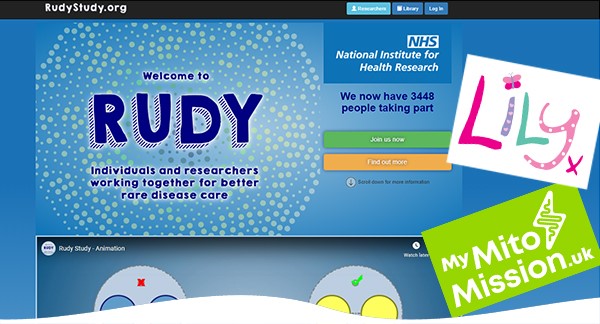
We have teamed up with our friends at The Lily Foundation to fund the inclusion of Mitochondrial Disease into the ‘RUDY Study’.

The RUDY Study is a groundbreaking mitochondrial research tool which will collate patients’ lived experiences of mito for use by research scientists.

Please read The Lily Foundation’s excellent article here.

Enabling More Vital Mito Research.

Rudy StudyThanks to supporters like you, we are thrilled to be helping to enable new research which has patients very much at the heart of it.

We have teamed up with our friends at The Lily Foundation to fund the inclusion of Mitochondrial Disease into the ‘RUDY Study‘.

The RUDY Study is a groundbreaking mitochondrial research tool which will collate patients’ lived experiences of mito for use by research scientists.

Please read The Lily Foundation’s excellent article here for more information.

Grants Update

Thanks to our fabulous supporters, we were able to contribute to an important new study through our friends at The Lily Foundation. Due to start next month, this study will explore the links between mito and neuropsychiatric diseases – a blanket term that covers a broad range of medical conditions involving neurology and psychiatry.

Read more here about this exciting project which will hopefully lead to improved information, mental health care and treatments for mito patients.

Our previous grant funding projects through Lily have been:
– 4-year gene editing research project
– support weekend for young adults
– enabling mitochondrial disease to become a part of The RUDY Study
… more information on all of these projects through the links.

With your amazing help, we’ll continue to raise awareness and hopes of treatments and a cure for mitochondrial disease, and support for those affected.

Grants Update.

Grants UpdateThanks to our fabulous supporters, we were able to contribute to an important new study through our friends at The Lily Foundation. Due to start next month, this study will explore the links between mito and neuropsychiatric diseases – a blanket term that covers a broad range of medical conditions involving neurology and psychiatry.

Read more here about this exciting project which will hopefully lead to improved information, mental health care and treatments for mito patients. 

Our previous grant funding projects through Lily have been:

With your amazing help, we’ll continue to raise awareness and hopes of treatments and a cure for mitochondrial disease, and support for those affected.

Grants Update

Thanks to our fabulous supporters, we were delighted to grant funds this year towards enabling mitochondrial disease to be added to the Rudy Study. Check out more about this project on their website.
We’re also very excited to be able to contribute to research about mito and mental health which will begin next year. Both of these through our friends at The Lily Foundation

Our previous grant funding projects through Lily have been a 4-year gene editing research project and a support weekend for young adults affected by mitochondrial disease.
With your amazing help, we’ll continue to raise awareness and hopes of treatments and a cure for mitochondrial disease, and support for those affected.

Grants Update.

Grants UpdateThanks to our fabulous supporters, we were delighted to grant funds this year towards enabling mitochondrial disease to be added to the Rudy Study. Check out more about this project on their website.

We’re also very excited to be able to contribute to research about mito and mental health which will begin next year. Both of these through our friends at The Lily Foundation

Our previous grant funding projects through Lily have been a 4-year gene editing research project and a support weekend for young adults affected by mitochondrial disease.

With your amazing help, we’ll continue to raise awareness and hopes of treatments and a cure for mitochondrial disease, and support for those affected.

Valuable Research Into Treatments

Thanks to everyone’s incredible support, My Mito Mission is thrilled to announce that we have been able to grant an amazing £42,500 to The Lily Foundation.  The money will help fund three projects – research into treatment, research into a cure and the first ever support weekend for young adults with mitochondrial disease in November.

Research Into Treatments.

Research PercentageThanks to everyone’s incredible support, My Mito Mission is thrilled to announce that we have been able to grant an amazing £42,500 to The Lily Foundation.  The money will help fund three projects – research into treatment, research into a cure and the first ever support weekend for young adults with mitochondrial disease in November.